
November 13, 2026
How food and beverage manufacturers can identify financial exposure, give decision-makers greater confidence and protect major capital investments
Article Category:
There's a question every CFO should be able to ask during a capital project review and receive a reasonably confident answer to:
What do we currently expect this investment to cost, and what could change that number?
It sounds straightforward until you consider how much information is required to answer it properly.
The latest expenditure report may be accurate, but engineering is still finalising changes that will affect equipment specifications. Procurement has several supplier quotations awaiting approval, construction productivity is below the original estimate, and commissioning has yet to confirm the resources required for startup.
A development of each of these risks carries potential financial consequences, although those consequences may enter the forecast at different times.
For food and beverage manufacturers investing millions in new processing facilities, production line expansions and automation programmes, the quality of financial information directly influences the decisions leadership can make.
At Manchester Analytics, we believe financial fluency should travel across the project team, with every discipline understanding how its decisions influence the manufacturer’s overall capital investment and expected ROI.
Capital project financial management involves dozens of metrics, although owners benefit from concentrating executive discussions on a smaller set of indicators that reveal meaningful changes in performance.
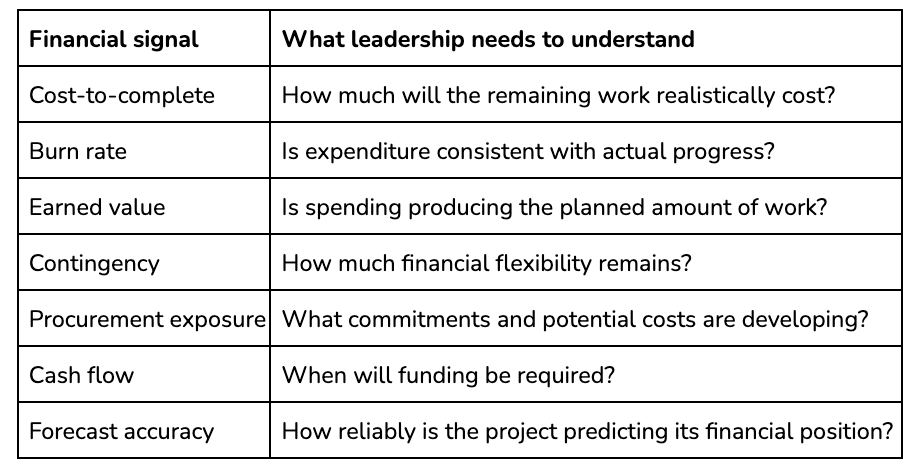
These indicators become particularly useful when interpreted together and connected to the business case that justified the investment.
The estimate at completion (EAC) represents the current expectation of a project's final cost. It combines actual expenditure with the estimate to complete (ETC), which should reflect the latest understanding of the remaining work.
For a food manufacturer expanding an existing processing facility, this includes outstanding equipment commitments, installation productivity, engineering changes, contractor claims, commissioning requirements and unresolved risks.
A project may be spending less than planned because procurement activities have moved into a later reporting period or construction has fallen behind schedule. If the forecast continues to rely on outdated assumptions, leadership may underestimate the resources required to finish.
Owners should challenge three areas during financial reviews:
A credible cost-to-complete forecast gives the CFO and Project Director a shared understanding of the expected final cost and the assumptions most likely to influence it.
Burn rate measures expenditure over a defined period, while earned value management evaluates performance against the approved cost and schedule baseline.
Look at a packaging line installation where the project team increases contractor working hours to recover lost time. Monthly expenditure rises, prompting leadership to assess whether the additional labour is delivering the anticipated improvement in installation progress.
Earned value provides a structured basis for examining that relationship.

If a project has spent $8 million completing work with an earned value of $7 million, its cost performance index is 0.875. The project is achieving approximately $0.88 of budgeted work for every dollar spent.
The accuracy of this analysis depends on reliable progress measurement and an appropriate baseline, particularly across equipment delivery, installation, testing and commissioning.
Owners should also think about whether acceleration expenditure is protecting an important commercial objective, such as maintaining production continuity or achieving a critical startup date.
Contingency provides a financial allowance for uncertainty within the defined project scope. Its adequacy depends on the risks it is expected to cover and how those risks evolve throughout delivery.
A manufacturer may have $3 million remaining, with several engineering changes awaiting final pricing, an unresolved contractor claim and outstanding commissioning requirements. The remaining balance alone does not show whether the project is financially protected.
Leadership needs a holistic view of the risks behind that exposure before deciding whether contingency or management reserve should be used. Not every change in risk status warrants additional expenditure, and releasing funds without understanding the wider project impact can quickly erode financial protection and expected ROI.
A meaningful contingency review should establish:
For CFOs, this supports more informed capital allocation and protects funds from being deployed unnecessarily. For Project Directors, it provides a clearer basis for deciding when intervention is required and whether sufficient financial flexibility remains for the outstanding work.
The risk register, change management process and financial forecast should therefore provide a consistent view of exposure, helping leadership direct contingency and management reserve towards risks where financial intervention is justified.
Equipment procurement can represent a substantial proportion of a food and beverage manufacturer's capital investment, particularly when projects involve specialised processing machinery, automation systems and long-lead equipment.
The initial purchase order establishes an important commitment, although financial exposure can change as engineering specifications develop and supplier performance becomes clearer.
An equipment supplier may propose revised delivery terms following an engineering change. Procurement could maintain the original delivery date through expedited manufacturing, but the decision may involve additional expenditure, earlier payment milestones or revised contractual responsibilities.
The commercial implications need to be assessed alongside installation requirements, commissioning dependencies and production commitments.
We believe procurement exposure should be reflected in the financial forecast as soon as it can be reasonably assessed, with Procurement, Engineering and Project Controls working together to establish the wider implications.
Cash flow forecasting provides visibility into the timing of expenditure and how those requirements align with the manufacturer's wider financial commitments.
An equipment supplier requesting accelerated payments may increase near-term funding requirements without changing the total contract value. A delayed installation programme may also shift expenditure into a period when the manufacturer expected the new facility to begin generating revenue.
For CFOs, these developments influence liquidity planning, financing requirements and capital allocation across other investments.
A useful forecast should incorporate current supplier payment schedules, contractor expectations, project changes and commissioning requirements, with significant movements clearly explained.
Forecast accuracy deserves greater attention during executive project reviews because financial management is, in practice, de facto risk management.
If the expected final cost increases every month, leadership needs to understand which assumptions are changing, what risks are driving those movements and whether the exposure could have been identified earlier. Equally, a forecast that remains unchanged despite significant engineering revisions, procurement developments or construction difficulties should warrant investigation.
Owners should review forecast movements over time, test the reliability of the underlying data and establish whether emerging risks are being consistently reflected in the numbers. This creates a clearer view of current exposure and its potential impact on contingency, management reserve and expected ROI.
A reliable forecast should communicate the expected outcome, the assumptions supporting it and the uncertainty that could change the final position. Connecting that financial intelligence with the wider project risk profile gives leadership a stronger basis for protecting the business case and making decisions while there is still time to influence the outcome.
These financial indicators become even more valuable when leadership understands how they influence one another.
An engineering revision may increase procurement costs, alter the installation sequence and create additional commissioning requirements. Together, these risk dependencies can drive cost and scope creep, change the trajectory of financial performance and put expected ROI under pressure.
Reducing the visibility gap requires information from across the project to be evaluated collectively. Through Velara, Manchester Analytics connects project intelligence to identify developing risks, dependencies and their financial implications, helping owners make informed decisions while there is still time to influence the outcome.
For CFOs, Procurement leaders, COOs and Project Directors, that shared view improves decision-making and the quality of communication around cost, schedule, contingency, funding and operational readiness.
Better visibility into financial performance and risk ultimately supports better decisions, clearer communication and a better-protected ROI.
